
Most retirement tax strategies focus on what to do this year. But the real opportunity lies in managing taxes across your entire lifetime — and that’s exactly what our new white paper explores.
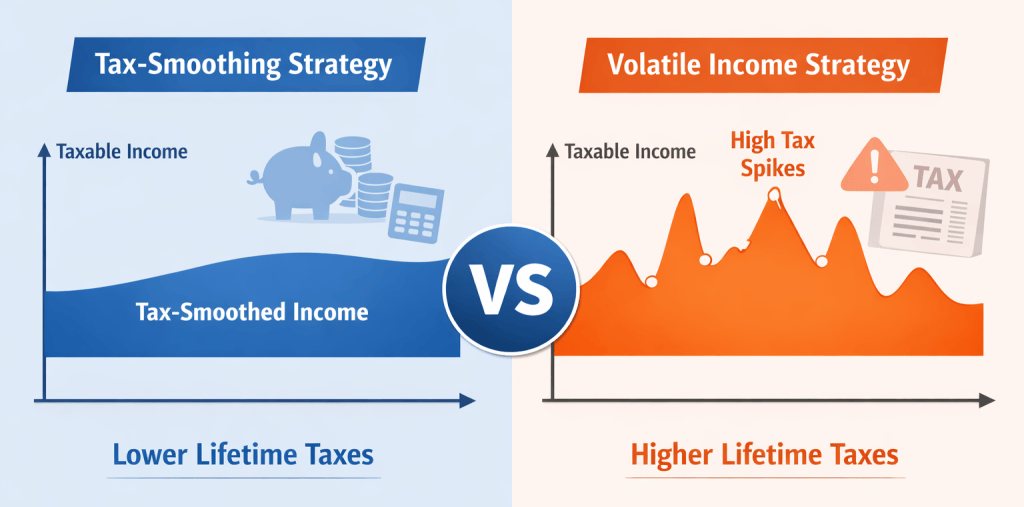
The paper, “Tax Smoothing: A Roth Conversion Framework for Maximizing After Tax Net Worth,” breaks down the research behind the Roth IRA Conversion Optimizer and explains why smoothing taxable income over time can dramatically increase after-tax net worth.
Here are the core ideas in plain English:
- Progressive taxes reward consistency. Because tax brackets rise as income rises, spreading income more evenly across years typically results in lower total taxes. This is the heart of tax smoothing.
- Economists have long argued for lifetime‑based taxation. Research dating back to Nobel laureate William Vickrey shows that taxing people based on lifetime income — not year‑to‑year spikes — is more efficient.
- Roth conversions help you self‑implement this idea. By converting strategically, you can “fill up” lower tax brackets in low‑income years and avoid being pushed into higher brackets later.
- Thresholds matter. Social Security taxation, Medicare IRMAA, NIIT, and ACA tiers can create sudden cost jumps. Being aware of these boundaries helps avoid unpleasant surprises.
- Today’s laws make this especially timely. SECURE 2.0, the permanent TCJA brackets, and the 10‑year inherited IRA rule all increase the value of thoughtful Roth conversion planning.
If you want the full research foundation — including citations, economic theory, and the modeling behind the Optimizer — you can read the complete white paper here: 👉 Read the full white paper