
Most Roth conversion calculators share one fatal flaw: they ask you to estimate your future tax rate in retirement. If you’ve ever used one, you’ve seen the prompt:
“What do you expect your tax rate to be in retirement?”
This single question undermines the entire calculation. If you already knew your future tax rate, you wouldn’t need a calculator in the first place. Yet, nearly every mainstream Roth tool relies entirely on this assumption.
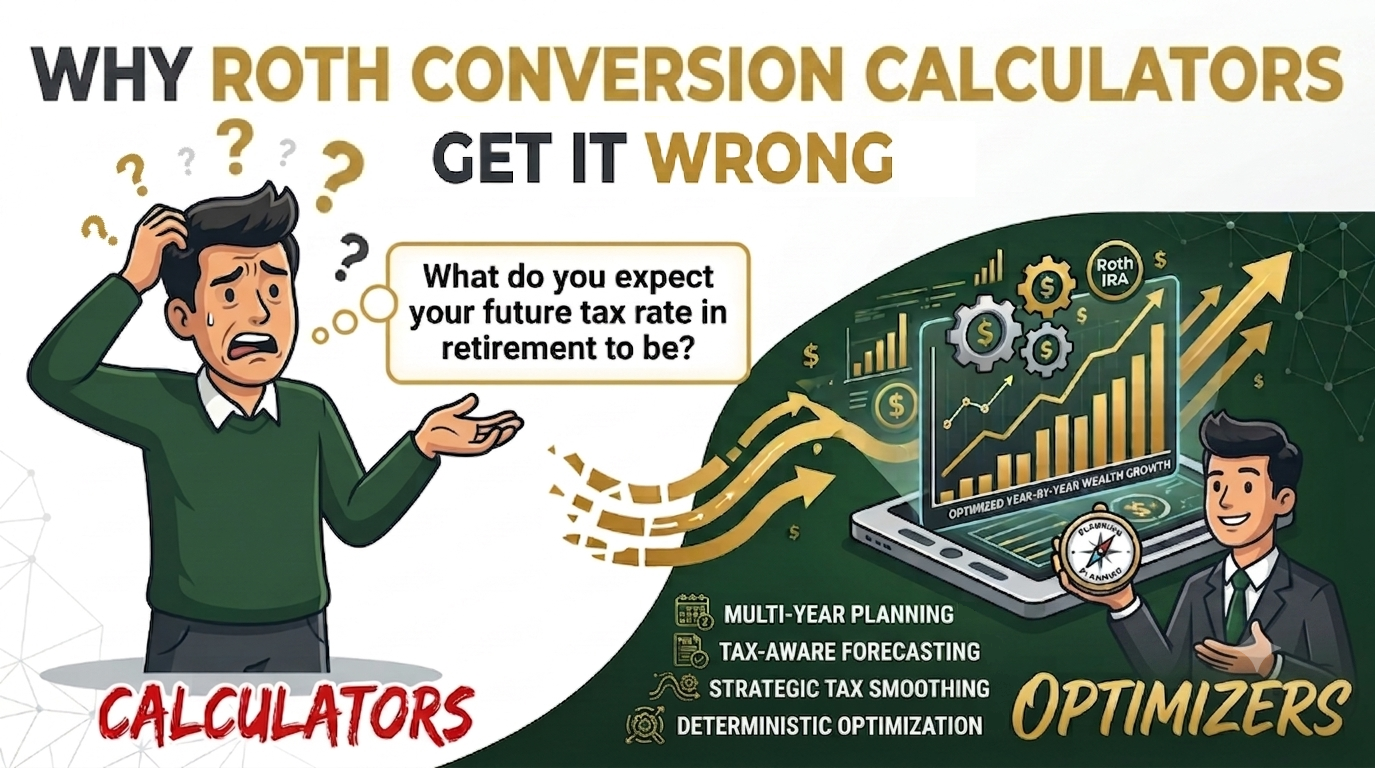
The problem isn’t just that the question is impossible to answer accurately. It’s that your future tax rate depends on the conversion strategy itself. This circular logic is exactly what makes the question mathematically incoherent.
Multi-year Roth optimizers solve this problem by calculating future taxes for you using a full retirement projection. That’s the difference between guessing and planning.
The Hidden Flaw in Standard Calculators
Most tools reduce Roth conversion planning to a simple, static comparison:
- Your tax rate today vs. Your guessed tax rate in retirement.
If you think your future rate will be higher, the calculator tells you to convert now. If you think it will be lower, it tells you to wait.
This sounds logical until you realize that your future tax rate is a moving target driven by dozens of compounding variables:
- Required Minimum Distributions (RMDs)
- Social Security taxation (the tax torpedo)
- IRMAA Medicare surcharges
- Net Investment Income Tax (NIIT)
- Pension income & investment returns
- Sunsetting federal legislation & state tax changes
No one can accurately guess the combined impact of these variables. More importantly, the calculator is asking you to manually input a value that the conversion strategy itself actively alters.
- Convert more today -> Future pre-tax balances shrink -> Future RMDs drop -> Future tax rate goes down.
- Convert less today -> Future pre-tax balances compound -> Future RMDs grow -> Future tax rate goes up.
In economic terms, your future tax rate is endogenous—meaning it is an internal output driven entirely by your strategy, not a static input you can guess. Any calculator that treats it as a static input is fundamentally flawed.
Why Guessing Leads to Costly Decisions
When forced to plug in a random guess, three predictable errors occur:
1. Underestimating Future RMDs
Pre-tax IRAs grow aggressively over decades, especially during strong market cycles. Underestimating their future size leads people to severely under-convert during their low-tax retirement windows.
2. Ignoring Threshold-Based Surtaxes
Surcharges like IRMAA and NIIT don’t behave like standard progressive tax brackets. Because they switch on suddenly at specific income thresholds, a guessed, flat tax rate completely misses these sharp financial spikes.
3. Assuming Bracket Stability
Legislation and federal inflation adjustments redraw tax brackets over a multi-decade retirement. A flat guess treats tax brackets as a frozen grid, ignoring the reality that boundaries shift over time.
Why Optimizers Provide Better Results
Standard calculators are built on single-year frameworks, meaning they lack the multi-year model required to calculate future tax rates. Because they can’t see the long-term horizon, the focus tends to default to minimizing taxes for the current year.
Multi‑year optimizers take a fundamentally different approach. They use a future tax‑aware model that projects income, RMDs, Social Security taxation, IRMAA, NIIT, and bracket inflation across your entire retirement horizon. This allows them to calculate how each year’s conversion affects both future taxes and long‑term net worth.
The most advanced optimizers go further by combining tax smoothing with a deterministic search process. Instead of guessing, they compute the optimal Roth conversion amount for every year in the forecast — resulting in a plan that minimizes lifetime taxes and maximizes lifetime wealth.
This transforms Roth conversion planning from a guessing exercise into a precise mathematical optimization.
A Simple Example
Imagine a retiree who avoids a 22% bracket conversion today because they “think” their future rate will be lower.
Fast forward fifteen years:
- Aggressive RMDs push them into a 32% federal bracket.
- Crossing the threshold triggers the 3.8% NIIT surtax on their investments.
- The sudden income spike moves them up three tiers of IRMAA cliffs, adding thousands in annual Medicare premiums.
Their guessed tax rate was completely wrong, and that single-year mindset easily cost them six figures in avoidable lifetime taxes. A multi-year optimizer would have mapped out this tax trap decades in advance.
Conclusion: From Guesswork to Precision
Most Roth calculators ask you to predict the unpredictable—and to guess an input that changes based on the very decision you are trying to make.
If you want to make Roth conversions a predictable driver of lifetime wealth, you need a tool that is tax-aware and multi-year. That is what a true Roth IRA Conversion Optimizer delivers.