
High‑net‑worth clients often ask a simple question: “How far out should we project when planning Roth conversions?”
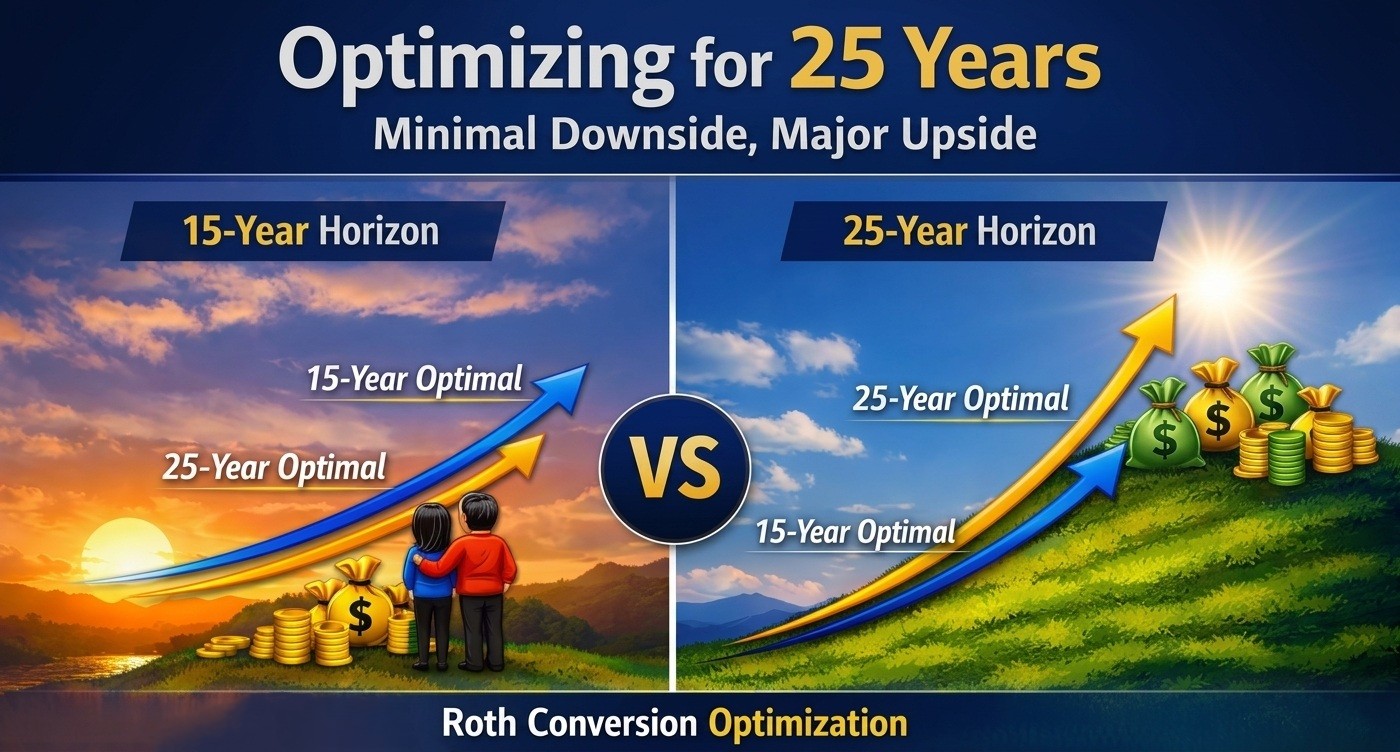
Most advisors default to a 20–30 year horizon, but many clients think in shorter windows — 10 to 15 years. To answer this question, we modeled the same MFJ couple from our previous case study under two different projection horizons:
- 15‑year horizon
- 25‑year horizon
In both cases, we compared:
- Baseline (no conversions)
- Fill the 22% bracket ($240k)
- Optimal income target for 15 years ($480k)
- Optimal income target for 25 years ($610k)
The results reveals a powerful insight: The the aggressive 25‑year strategy performs almost as well at 15 years while performing significantly better at 25 years.
The Results
We first used the Optimizer to calculate the optimal income target for both the 15 year and 25 year horizons:
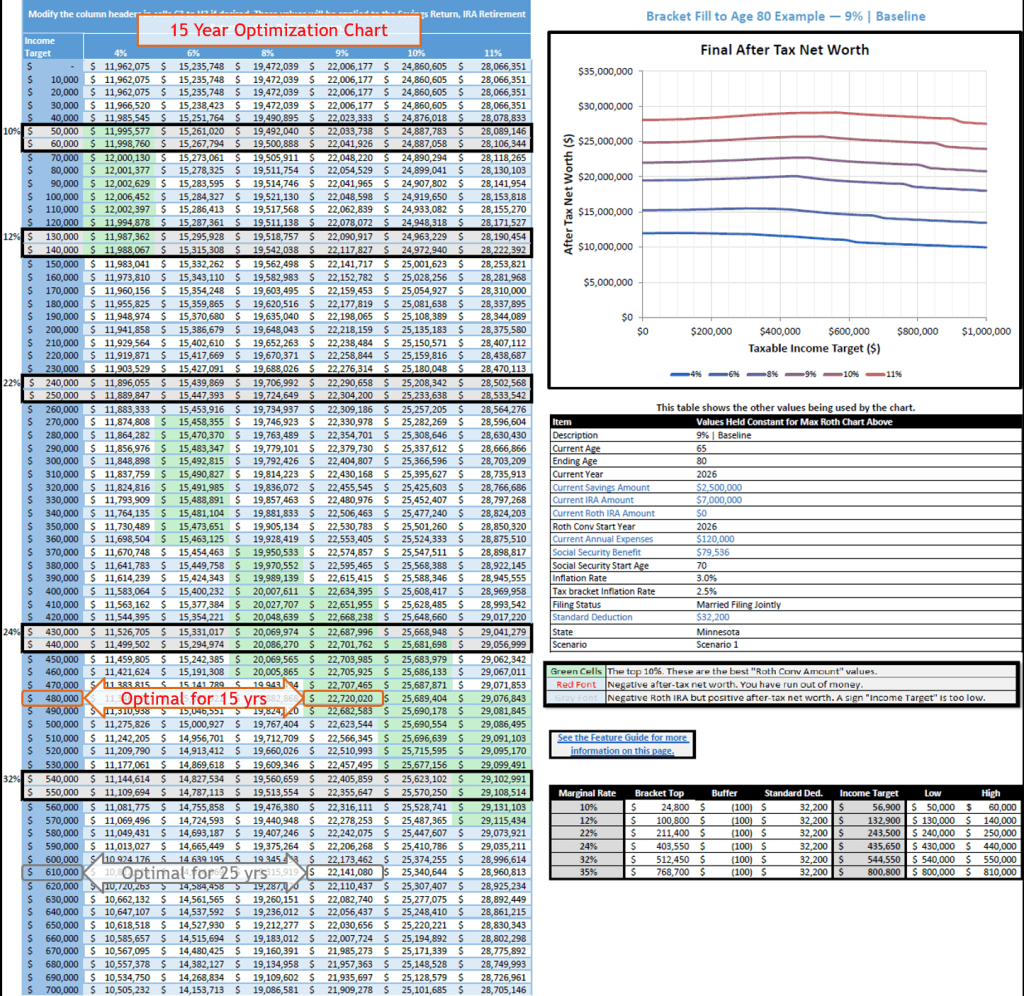
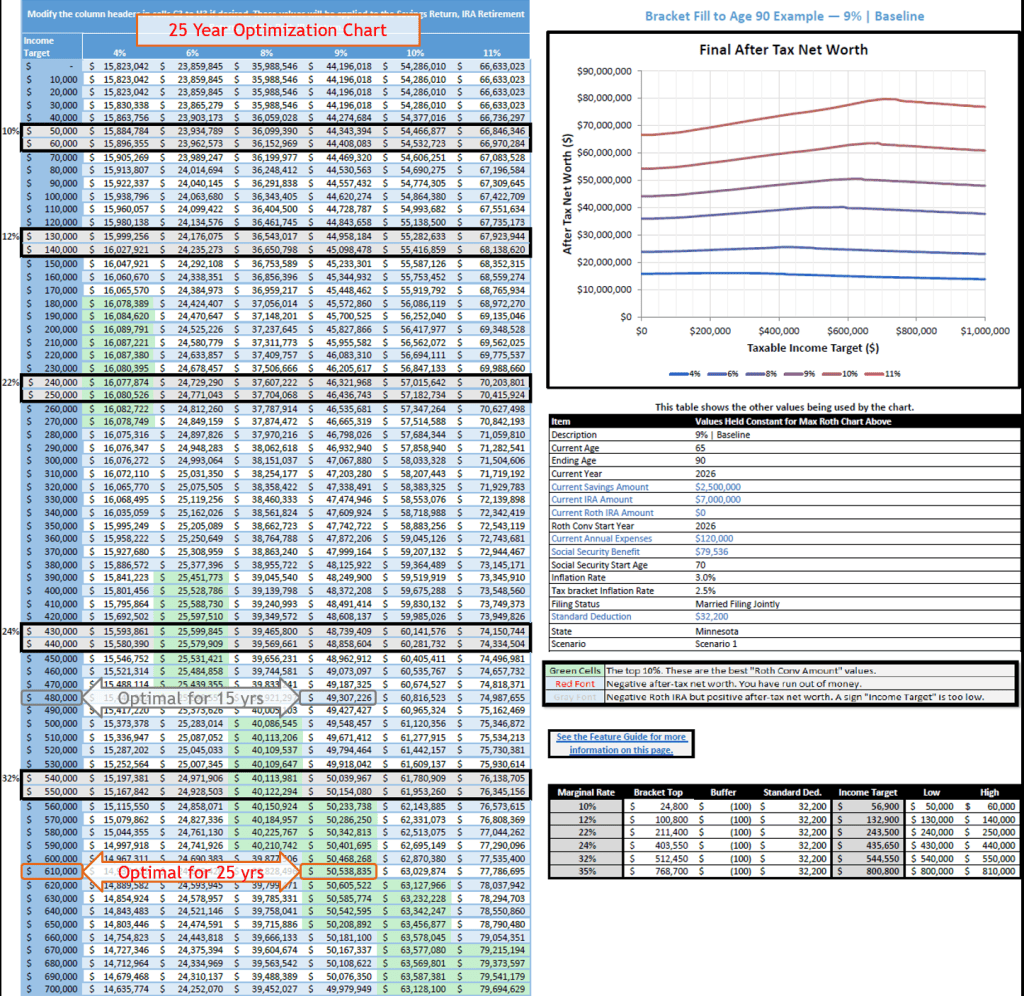
Note: “Income Target” is the inflation-adjusted tax-smoothed income level that is targeted by the Roth conversions.
We found that even at 15 years, the optimal income target is double the 22% bracket fill and at 25 years, the optimal income target 2.5× the 22% bracket fill.
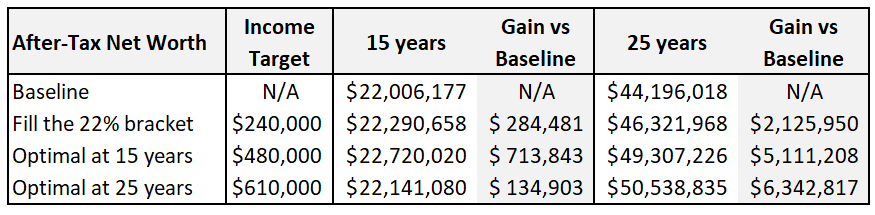
The 15 year strategy at 15 years increased wealth by $714k over baseline. The 25 year strategy at 25 years increased wealth by $6.3M over baseline.
Key Insights Advisors Should Take From This Case Study
1. Optimization beats 22% bracket‑fill
Even with only 15 years to work with:
- Bracket‑fill adds: +$284k
- 15‑year optimal adds: +$714k
That’s a $430k improvement over bracket‑fill.
At 25 years:
- Bracket‑fill adds: +$2.13M
- 25‑year optimal adds: +$6.34M
That’s a $4.2M improvement over bracket‑fill.
Takeaway: Bracket‑fill helps, but still underperforms relative to true optimization.
2. Income Target grows with horizon
Optimal income target (and associated Roth conversion):
- 15‑year optimal: $480k
- 25‑year optimal: $610k
Shorter horizons mean:
- Less time for Roth compounding
- Less time for RMD suppression
So the Optimizer naturally selects a smaller target.
Takeaway: The Optimizer adapts intelligently to horizon length.
3. The 25‑year strategy has minimal downside at 15 years
After-tax net worth at 15 years
- 15‑year optimal: $22.72M
- 25‑year optimal: $22.14M
- Difference: -$580k
After-tax net worth at 25 years
- 15‑year optimal: $49.31M
- 25‑year optimal: $50.54M
- Difference: +$1.23M
Takeaway: The aggressive 25‑year plan has minimal downside at 15 years but produces over $1.2M more wealth at 25 years.
4. Additional 25-year tailwinds
While not specifically modeled in this case study, there are additional benefits to the larger conversions in the 25-year strategy.
- Widow Tax Shield: Prevents a surviving spouse from being forced into single-filer brackets with large taxable RMDs.
- Estate Tax Reduction: Paying tax upfront reduces the gross estate value while transferring growing tax-free assets.
- 10-Year Inherited IRA Rule: Clears out traditional IRA balance so heirs aren’t hit with high-bracket distributions during peak earnings.
- Legislative Tax Risk: Locks in today’s known tax brackets to hedge against future statutory rate hikes, bracket threshold shifts, and federal debt-driven tax policy changes.
Final Conclusion
In this case study we found that:
- Optimization beats bracket‑fill at both horizons
- The optimal income target increases with horizon length
- The 25‑year strategy is nearly as good at 15 years
- The 25-year strategy is is $1.2M better at 25 years
- The 25-year strategy is better for widow tax and estate tax
Every client’s financial picture is unique. The Roth IRA Conversion Optimizer gives advisors the clarity to model these exact trade-offs side by side—empowering clients to move past simple rules of thumb and make confident, optimal decisions.