
Why Time Horizon and Rate of Return Drive Asymmetric Payoffs — And Why Most Tools Miss It
When advisors talk about Roth IRA conversions, the conversation usually centers on tax brackets, RMD suppression, and long‑term compounding. But beneath all of that lies a deeper, more powerful truth:
Roth conversion strategies are highly sensitive to two variables: (1) Time horizon, and (2) Rate of return.
Understanding these sensitivities — and quantifying their payoff ratios — is one of the most important steps in designing a truly optimal Roth conversion plan.
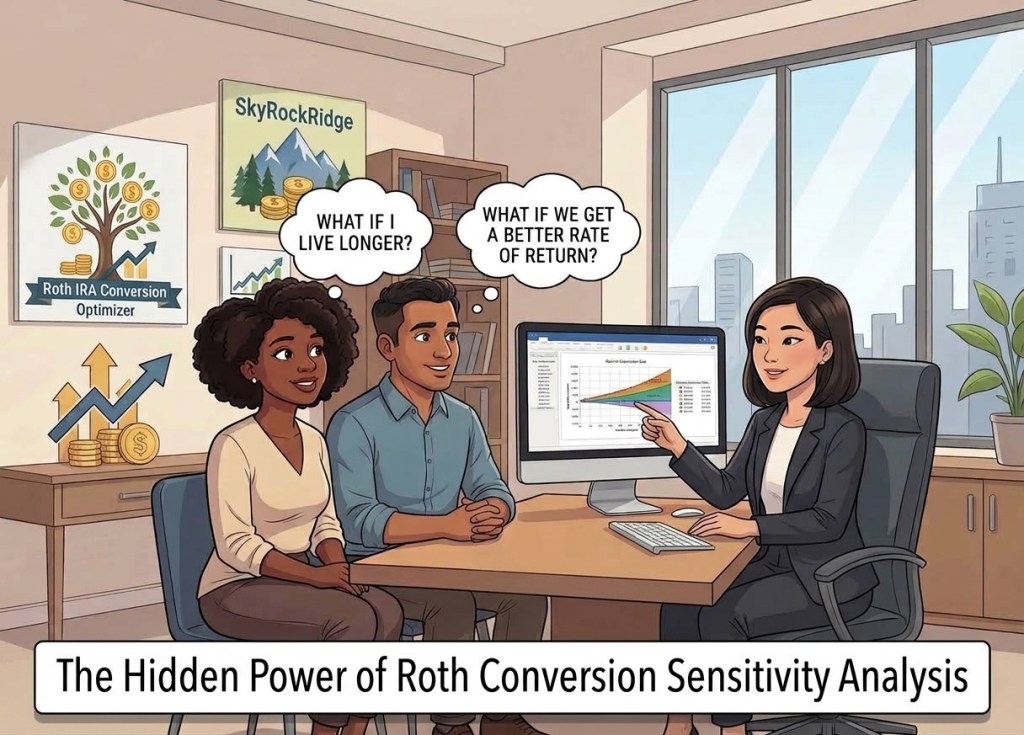
A Note on Defining “Downside Risk”: When evaluating sensitivity scenarios, “downside risk” does not refer to portfolio market loss. Rather, it represents the potential reduction in after-tax net worth if you optimize a plan for an upside scenario—such as living longer or achieving higher market returns—that ultimately does not occur. By converting more aggressively upfront to capture that potential upside, you risk over-converting relative to the baseline. If the client dies earlier or returns fall short, the “downside” is simply the incremental tax friction from paying more tax up front than proved strictly necessary.
1. Sensitivity #1: Time Horizon
What happens if your client lives 10 years longer — or 10 years less?
Time horizon is one of the strongest drivers of Roth conversion value. The longer the client lives:
- The more years Roth assets compound tax‑free
- The more years RMDs compound tax drag
- The more years IRMAA, NIIT, and Social Security taxation thresholds matter
- The more years bracket inflation widens conversion opportunities
- The more years an inherited IRA grows, impacting estate and heir income tax.
This leads to a simple but powerful rule of thumb:
Longer horizons → larger optimal conversions.
But the real insight comes from measuring how sensitive the strategy is to horizon changes.
The Asymmetry of Time Horizon Payoffs
High‑net‑worth families often see 5× payoff ratios or more when comparing short vs. long horizons. That means:
- For $1 of downside risk, the upside can be $5 or more.
- For $1M of conversion tax cost, the payoff can exceed $5M in lifetime net worth (if the client lives longer than expected).
This asymmetry is exactly what advisors need to show clients who hesitate to convert “too much.”
2. Sensitivity #2: Rate of Return
What if returns are 3% higher — or 3% lower — than expected?
Rate of return sensitivity is equally important. Higher returns amplify Roth compounding and magnify the drag of RMDs. Lower returns reduce the benefit of Roth conversions — but not symmetrically.
The second rule of thumb is similar:
Higher returns → larger optimal conversions.
But again, the real insight is in the payoff ratio.
The Asymmetry of Return Sensitivity
Across a number of client case studies, we’ve seen:
- Greater than 5× payoff ratios
- A 3% return increase adding millions in Roth value
- A 3% return decrease reducing value only modestly
This is classic asymmetric risk‑reward:
Small downside, massive upside.
For high‑net‑worth clients, this is exactly the kind of tradeoff they want to take — but only if the advisor can quantify it.
3. Why Most Tools Fail to Show These Payoffs
While existing tools run Monte Carlo simulations to test overall portfolio survival, this is not the same as Roth conversion sensitivity. These tools fall short for three reasons:
A. They don’t calculate a true optimal conversion.
They typically “fill the bracket,” which is almost never optimal — especially for HNW families.
B. They don’t model horizon sensitivity.
You’d have to manually run multiple scenarios at multiple horizons and manually compare results.
C. They don’t model return sensitivity.
You’d have run multiple scenarios at multiple rates of return and manually compare results.
This is why advisors rarely talk about payoff ratios — their tools don’t compute them.
4. Shedding Light on the Asymmetry and Payoff Ratios
Advisors need a tool that will clearly show the asymmetry and payoff ratios. To do this, the tool needs to do the following.
- Implement tax smoothing across the projection horizon.
- Deterministically find the optimal conversion amount for a given scenario.
- Run the optimization function across multiple time horizons.
- Run the optimization function across multiple rates of return.
- Automatically calculate the payoff ratios
This transforms Roth planning from guesswork into quantitative strategy, allowing advisors to finally answer questions like:
- “How sensitive is my plan to living longer or market returns?”
- “What’s the payoff ratio of converting more aggressively?”
And clients can finally see why larger conversions often make sense — especially when the upside is 5× the downside.