
When couples reach age 80, Roth conversion planning often feels overwhelming. Many decide to “do nothing” simply because it seems easier. No big tax bill, no paperwork, no disruption. Just let the IRA grow and deal with it later.
But for an 80‑year‑old married couple with a 10‑year planning horizon, doing nothing is actually the most complicated and most expensive path.
The surprising result is:
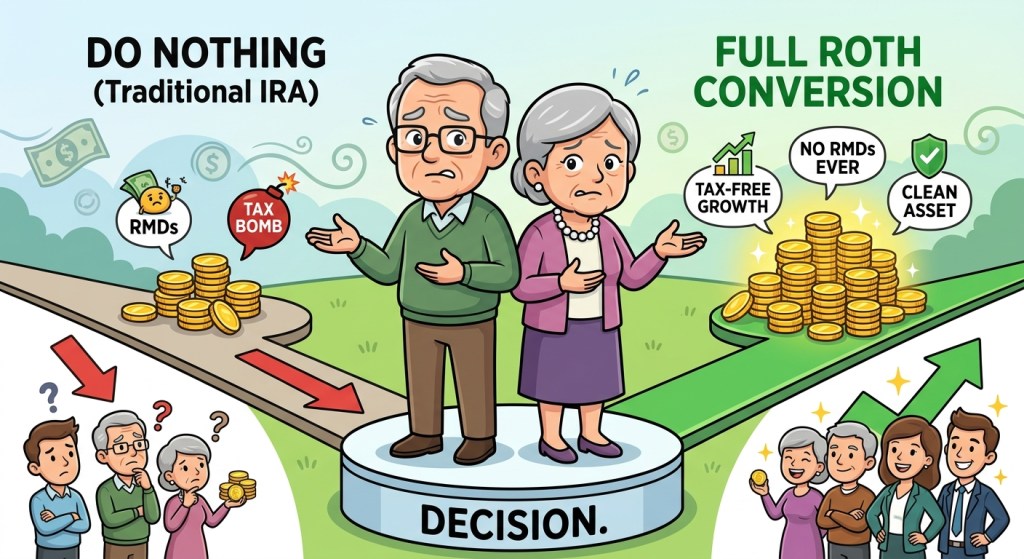
A complete Roth conversion strategy beats doing nothing. Whether executed aggressively in Year 1 or smoothed over a few years, eliminating the Traditional IRA removes RMD headaches, avoids widow-tax traps, and leaves heirs with significantly more in net value.
And while converting everything is not mathematically optimal, it is far better than doing nothing.
The Couple’s Starting Point
- Age: 80
- Projection horizon: 10 years (to age 90)
- IRA: $1.5M
- Savings: $4M
- Roth IRA: $0
We model two paths:
- Do Nothing
- Convert Everything in One Year
The first spouse passes at age 83. The surviving spouse lives to age 90. This triggers the widow‑tax effect and the SECURE Act 10‑year rule for heirs.
The Results
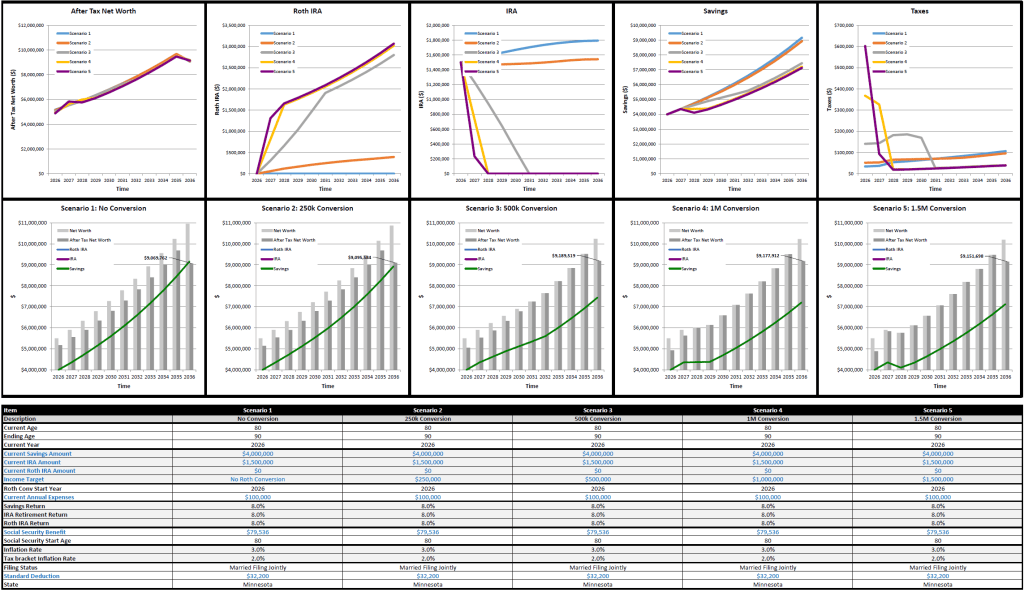
The image below from the Roth IRA Conversion Optimizer compares the following five scenarios.
- Doing nothing
- Roth conversions up to $250k income (not discussed in this post)
- Roth conversions up to $500k income (not discussed in this post)
- Roth conversions up to $1M income (not discussed in this post)
- Roth conversions up to $1.5M income
Why “Convert Everything” Is Actually Easier Than Doing Nothing
1. RMDs disappear permanently
Doing nothing means:
- RMDs every year
- Widow RMDs at higher Single brackets
- IRMAA spikes
- NIIT exposure
- Social Security taxation increases
Converting everything means:
- No RMDs ever again
- No forced income
- No bracket spikes
- No IRMAA cliffs
- No NIIT
- No Social Security taxation from IRA income
This is less work and less stress for an elderly couple.
2. The IRA stops growing into a tax bomb
Doing nothing allows the IRA to grow from $1.5M → ~$1.8M (at 8%). That growth is fully taxable and adds to the:
- RMDs
- IRMAA
- Widow tax
- Estate tax
- Heir income tax
- IRD deduction complexity
3. Shrinks the gross taxable estate (by prepaying income taxes)
A Traditional IRA carries an embedded income tax liability that heirs must eventually pay. But for estate tax purposes, the IRS counts the full gross value of the IRA—including that uncollected tax dollars—toward the estate threshold.
Converting to a Roth IRA doesn’t make the Roth exempt from estate taxes, but paying the conversion tax bill out-of-pocket directly reduces the taxable cash balance. Prepaying the IRS up front shrinks the total taxable estate, removing dollar-for-dollar what would otherwise sit in taxable savings subject to state estate tax.
4. The couple gets a decade of tax‑free Roth growth
Even if the conversion is “not optimal,” the Roth grows tax‑free for 10 years.
Doing nothing forces the IRA to grow taxably for 10 years.
The Hidden Benefit: The Heirs’ 10‑Year Rule
Most clients never understand how dramatically the SECURE Act 10‑year rule affects their heirs. But this is where the biggest difference appears.
Below is the correct apples‑to‑apples comparison using:
- 8% annual growth
- 40% effective tax rate on inherited IRA withdrawals
- Your inherited savings numbers:
- Do Nothing: $9M savings
- Convert Everything: $7M savings
🍎🍎 Apples‑to‑Apples Heir Comparison
Scenario A — Do Nothing
Heirs receive:
- $9,000,000 savings
- $1,800,000 traditional IRA*
*The Traditional IRA is smaller at age 90 because of RMDs
Annual inherited IRA distribution (8% portfolio return): $268,256 / year
Total gross inherited IRA withdrawals over 10 years: $2,682,557
Total heir income taxes paid annually at 40%: $1,073,023
Net IRA value to heirs (reinvested net cash at 8%): $2,163,000
Net growth from extra $2M savings (8% return for 10 yrs): $2,000,000
Additional MN Estate Tax: $120,000
Total inheritance: $9,000,000 + $4,043,000 = $13,043,000
Scenario B — Convert Everything
Heirs receive:
- $7,000,000 savings
- $3,000,000 Roth IRA
Roth grows at 8% for 10 years: $6,476,000
Heirs pay zero income tax
Total inheritance: $7,000,000 + $6,476,000 = $13,476,000
🔥 Heir Benefit Difference
$13,476,000 – $13,043,000 = $433,000
Even though the couple leaves $2M less in savings, their heirs end up with $433k more net value.
Why “Optimal” Doesn’t Make Sense at Age 80
Many advisors try to find the mathematically optimal Roth conversion path. But for an 80‑year‑old couple, “optimal” is not realistic.
Here’s why:
At age 80, the mathematically optimal Roth conversion strategy depends on knowing exactly how long each spouse will live.
But no couple can know whether one spouse will pass in three years, seven years, or twelve years — and the difference between those outcomes changes the optimal conversion path.
In other words, the “optimal” solution requires information that no one has.
That’s why the “convert everything” strategy is so powerful:
It doesn’t require predicting the future.
It guarantees that the couple captures most of the available tax savings, eliminates widow‑tax exposure, removes the IRA from the estate, and leaves heirs with a clean, tax‑free asset — regardless of how long either spouse lives.
Why the IRD Deduction Won’t Save the Heirs
Clients often ask whether the Income in Respect of a Decedent (IRD) deduction under IRC § 691(c) softens the income tax blow on the inherited $1.8M Traditional IRA.
The short answer is no.
The § 691(c) IRD deduction is only available to offset federal income tax if the estate paid federal estate tax on that specific IRA asset. Because this couple’s total estate falls below the federal estate tax exemption threshold ($15M+ per individual / $30M per couple in 2026), zero federal estate tax is owed.
While the estate may trigger state-level estate taxes (such as Minnesota’s $3M exemption threshold), state estate taxes do not generate a federal IRD deduction.
As a result, the heirs receive $0 in IRD tax relief, forcing them to pay full, unmitigated income tax on every dollar drawn from the Traditional IRA.
Final Takeaway
For an 80‑year‑old married couple with a modest IRA and a 10‑year horizon:
- Doing nothing is not simple
- Doing nothing is not cheap
- Doing nothing is not safe for heirs
The simplest, most reliable, and most impactful strategy is:
Execute a full Roth conversion strategy. Whether completed in Year 1 as a baseline or spread across a few years, eliminating the Traditional IRA removes RMDs, avoids widow-tax traps, and leaves heirs with millions more and a tax‑free asset that can grow for 10 years.
Even though the couple leaves $2M less in savings, their heirs end up with $433k more net value, and the couple and their heirs avoid a decade of tax complexity.
For couples at this age, simplicity is not just comforting — it’s financially powerful.