
I recently saw a comment from a user stating they didn’t need to worry about Roth conversions for estate planning because the Income in Respect of a Decedent (IRD) deduction would “get that money back” from federal estate taxes.
That perspective is dangerously wrong—and it could cost an estate millions.
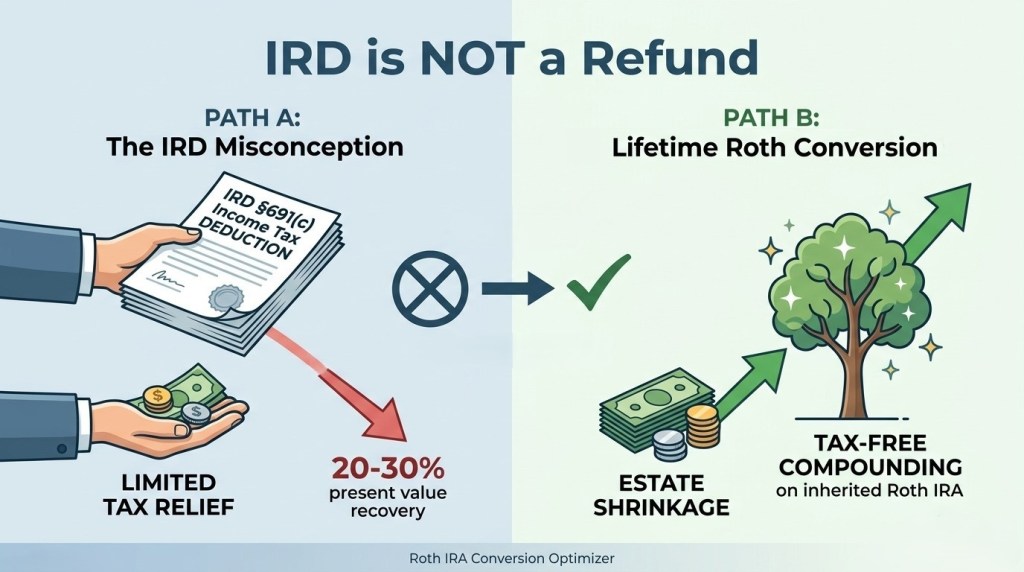
Here is why relying on IRC §691(c) to “fix” an estate tax problem is a major misconception:
1. A Deduction is Not a Refund
Section 691(c) provides an income tax deduction, not an estate tax refund or a dollar-for-dollar tax credit. If an estate pays $10M in estate tax on a pre-tax IRA, the beneficiary gets a $10M income tax deduction—not a $10M check from the IRS.
2. The Math Doesn’t Add Up
At the top federal income tax bracket of 37%, a $10M deduction saves $3.7M in income tax. You paid 100 cents on the dollar in estate tax upfront to get back 37 cents in tax relief down the road.
3. The Time Value of Money Drag
Under the SECURE Act’s 10-year rule, beneficiaries generally spread traditional IRA withdrawals over a decade. Because you can only claim the §691(c) deduction pro-rata as income is recognized, discounting those tax savings over 10 years reduces the true present-value recovery to just 20% to 30% of the original estate tax paid.
4. It Provides Zero Relief for State Estate Taxes
IRC §691(c) applies exclusively to federal estate tax paid. If an estate is subject to state estate taxes—which often kick in at much lower thresholds than the federal exemption—the §691(c) deduction offers no relief whatsoever. Beneficiaries get no deduction for state estate taxes paid, leaving that portion of the inherited IRA exposed to unmitigated double taxation.
Why Lifetime Roth Conversions Still Win:
• Estate Shrinkage: Paying income tax on a conversion during your lifetime uses taxable assets, directly reducing the size of your taxable estate.
• Tax-Free Compounding: Beneficiaries get up to 10 years of tax-free growth in an inherited Roth IRA—with $0 income tax due on distributions.
• No Complex Accounting: No need for beneficiaries to track, calculate, and itemize §691(c) deductions year after year.
The IRD deduction exists to soften the blow of double taxation. It does not make the estate whole, and it is certainly no replacement for deliberate, proactive Roth conversion strategy.