
Tax bracket modeling is a cornerstone of tax-aware retirement planning. Two powerful existing features set the foundation:
- Tax Bracket Inflation Rate (Scenario Set worksheet) — lets you adjust how tax bracket thresholds evolve over time to model inflation or legislative changes.
- Disable Tax Bracket Refresh (Settings worksheet) — enables modeling of entirely different tax bracket structures for more flexible and comprehensive scenario testing.
Building on these, we’re excited to introduce some new features that gives you more insight into your future tax situation.
- Main worksheet: Now displays the Marginal Federal tax rate for each year
- Tax Bracket worksheet: Now lets you instantly view federal and state tax brackets for any future year.
To look up a future bracket, you simply enter the Tax Year and Bracket Inflation Rate into the Tax Bracket worksheet. The Optimizer then automatically generates the projected federal and state brackets for that year based on your inflation assumptions, dynamically updating the right-hand side of the worksheet, giving you a clear, structured view of how your marginal tax landscape may evolve over time.
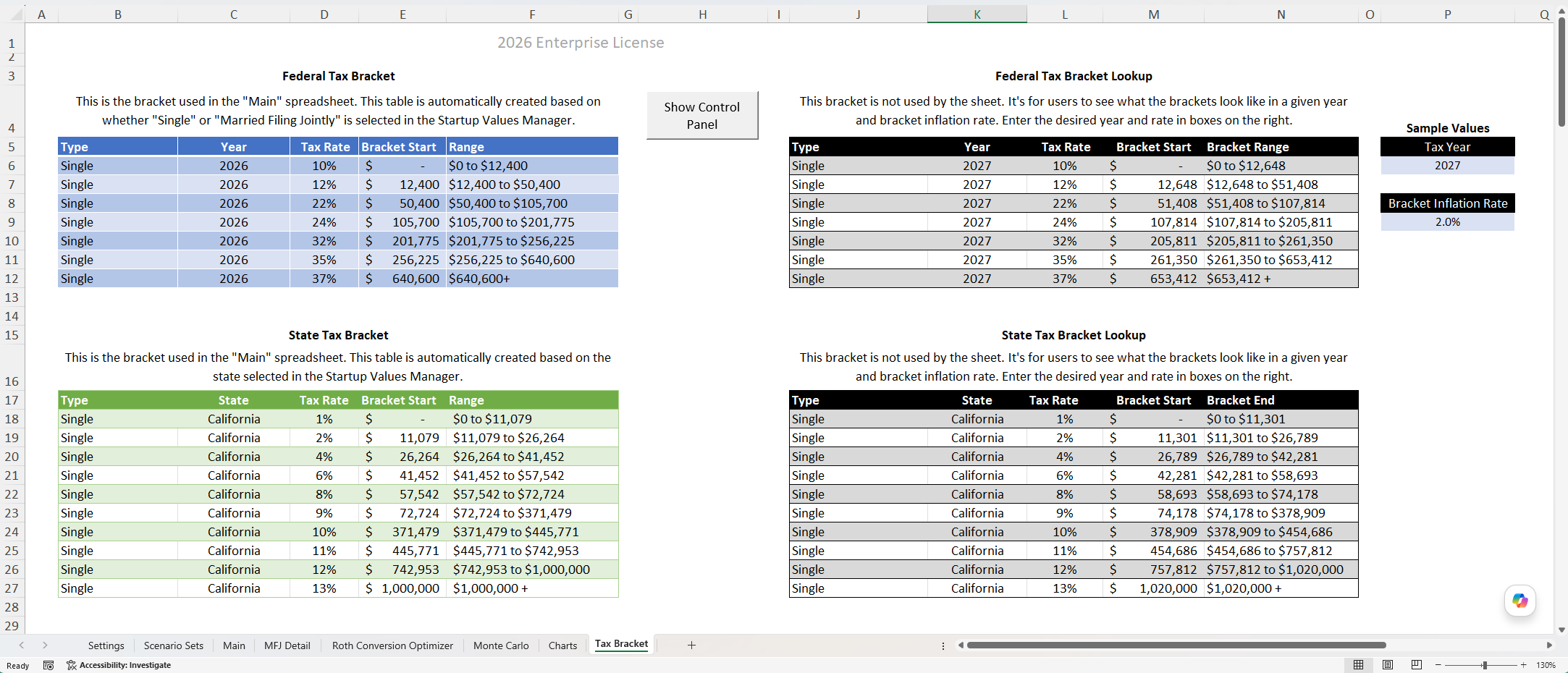
Together, these features provide unparalleled control and insight into how future tax brackets may influence your Roth conversion strategy.
Why This Matters: Planning Roth Conversions With Future Marginal Rates in Mind
Roth conversions are fundamentally a question of timing and tax rates. Converting at a lower marginal rate today to avoid higher rates later is the core value proposition. This new feature strengthens that analysis in several important ways:
1. See Your Future Marginal Tax Rates
Understanding what bracket you may fall into in 2027, 2028, or 2035 is essential for long‑range planning. With this feature, you can:
- View projected brackets for any year
- Compare them to your current bracket
- Identify windows of opportunity for lower‑tax conversions
This is especially valuable for retirees in the “gap years” between retirement and RMD age, when income is often temporarily lower.
2. Evaluate the Tax Cost of Future Conversions
Because the Optimizer now shows the projected bracket thresholds for future years, you can estimate:
- What marginal rate a conversion in that year would be taxed at
- Whether delaying a conversion increases or decreases your tax cost
- How inflation-adjusted brackets may shift your long-term strategy
This helps you avoid surprises and make more confident decisions.
3. Model Legislative Risk and Inflation Scenarios
Tax brackets evolve over time due to inflation and potential legislative changes. By adjusting the bracket inflation rate, you can model scenarios where future tax brackets shift higher or lower than expected, reflecting different economic or policy environments. This flexibility helps you understand how sensitive your tax planning is to these changes.
The “Disable Tax Bracket Refresh” feature further enhances this by allowing you to model entirely different tax bracket structures, giving you the ability to test more varied and complex scenarios beyond standard inflation adjustments.
4. Improve Multi‑Year Conversion Planning
Roth conversion planning is rarely a one‑year decision. It’s a multi‑year optimization problem.
With future-year bracket visibility, you can:
- Map out a multi‑year conversion schedule
- Smooth taxable income across years
- Avoid IRMAA cliffs and NIIT thresholds
- Coordinate conversions with Social Security, pensions, and RMDs
This aligns perfectly with the Optimizer’s mission: helping users minimize lifetime taxes and maximize lifetime wealth.
5. Strengthen Advisor–Client Conversations
For financial professionals using the Commercial Edition, this feature provides a visual, data‑driven way to explain:
- Why conversions make sense now
- How future tax brackets affect long-term outcomes
- The tradeoffs between converting early vs. waiting
Clients understand better when they can see the brackets.
A More Complete View of Tax‑Aware Retirement Planning
This new capability joins the Optimizer’s growing suite of tax‑intelligent features, including:
- Optimizing Roth conversions
- Federal tax bracket modeling
- State tax bracket modeling
- Social Security taxation
- LTCG and NIIT awareness
- Medicare IRMAA thresholds
- Early withdrawal penalty logic (72t, Rule of 55)
- After‑tax IRA basis support
- Monte Carlo risk analysis
Together, these tools give users a comprehensive, end‑to‑end view of how Roth conversions affect lifetime taxes, retirement income, and long‑term net worth.
